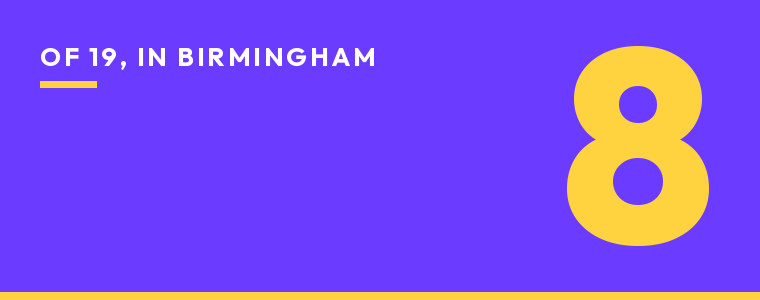
There are 19 grammar schools in the West Midlands partnership, they all use one entrance test, and your child sits it once. What they do not share is a pass mark. Each school or foundation sets its own, and the gap between them is wide enough to change who gets a place.
That single fact is where most of the confusion in this process lives, so the list below is grouped by who sets the score, not alphabetically.
All 19 schools
| Area | Schools |
|---|---|
| Birmingham and Sutton Coldfield (8) | King Edward VI Camp Hill Boys, King Edward VI Camp Hill Girls, King Edward VI Five Ways, King Edward VI Handsworth Grammar School for Boys, King Edward VI Handsworth School for Girls, King Edward VI Aston, Bishop Vesey's Grammar School, Sutton Coldfield Grammar School for Girls |
| Walsall, Wolverhampton and Shropshire (5) | Queen Mary's Grammar School (Walsall), Queen Mary's High School (Walsall), Wolverhampton Girls' High School, Haberdashers' Adams (Newport), Newport Girls' High School |
| Warwickshire (6) | Alcester Grammar School, Ashlawn School, King Edward VI School Stratford-upon-Avon, Lawrence Sheriff School, Rugby High School, Stratford Girls' Grammar School |
That grouping comes from the partnership's own school list. Note that only eight of the nineteen are in Birmingham. Families routinely plan as though the Birmingham eight are the whole picture.
One test, three different ways of setting the bar
the partnership entrance test page sets the format: two papers, covering verbal reasoning, non-verbal and spatial reasoning, English and mathematics, weighted 50% English and verbal reasoning, 25% non-verbal, 25% maths. Results are standardised for age around a median of 200 across the whole partnership.
After that, the schools diverge completely.
- Birmingham: the King Edward VI Foundation sets one qualifying score across its schools. For 2026 entry that was 205, with a priority score of 224.
- Walsall, Wolverhampton, Shropshire: each school sets its own. Queen Mary's Grammar School published a minimum qualifying score of 180 for September 2026 entry.
- Warwickshire: a Committee of Reference sets two figures per school each year, an Automatic Qualifying Score and a lower minimum standard that governs the waiting list.
A child on 201 has missed the Birmingham threshold and comfortably cleared the Walsall one. Same child, same paper, same morning.
The box you have to tick, and the marks that do not travel
This is the one I most want parents to read twice, because it is procedural and it is fatal.
Your child's result is not automatically visible to every school in the partnership. At registration, in May and June of Year 5, you have to indicate which schools you want the result shared with. Haberdashers' Adams, for instance, requires you to tick SWW on the online form, and states plainly that a child whose data was not shared will not be considered even if the school is named on the local authority preference form in October.
So you can sit the test, score well, name the school, and never be in the running. Get the registration form right in June. There is no repairing it in November.
Catchment is where the real damage is done
The score gets all the attention. In practice, catchment decides more outcomes, and it is the part families understand least.
The King Edward VI schools use ward-based catchment areas that differ school by school, so one address can sit inside one and outside another. Wolverhampton Girls' has no catchment at all. Alcester's priority area is a circle of a defined radius drawn from a fountain in Stratford-upon-Avon. Newport Girls' ties its pupil premium route to a list of Telford primary schools.
Nineteen schools, nineteen sets of rules, and the maps are genuinely hard to read. Work yours out in September, not in the fortnight after results, because a misread map turns into a wasted preference and then into a long wait on a list.
How to build a shortlist from nineteen
- Start with travel, not scores. Rule out anything you would not actually do daily for five years.
- Check catchment for each survivor, by ward or priority area, against your real address.
- Note who sets the score for each one. Do not assume 205 applies outside the Foundation.
- Tick the sharing boxes at registration for every school on the list.
- Rank truthfully in October. Under equal preference, ambition at the top costs you nothing below it.
See our guide to Foundation catchment, and our guide to why Walsall's scores differ.
See where your child stands today
Timed sections in the GL Assessment format, marked instantly, with a topic-by-topic breakdown. No sign-up to start.
The research gap that costs families a place
The biggest problem I see is not ability, it is research. Parents inside a Birmingham postcode look at the Birmingham schools and stop there. The cut-off scores are different for Birmingham and Walsall, the marks are shared across the partnership, and a child who falls just short of 205, on 200 or 201 or 202, still has real options. That is even more true now if pupil premium applies.
Two things undo families every year. The first is that tick box at registration, confirming you want your result shared with the other schools. Miss it and your marks simply do not travel.
The second is the catchment maps. Most parents never really learn to read them, and that is where the miscalculations happen. With the volume of applications Birmingham receives, an error there does not just cost you a preference. It can mean five or six months on a waiting list before a place comes up. That is a long time for a child to be in the wrong school.
Mushtaque Ahmed, Founder of GrammarPath and Bright Mentors
Frequently asked questions
How many grammar schools are there in the West Midlands?
Nineteen, in one partnership sharing a single entrance test. Eight are in Birmingham and Sutton Coldfield, five are in Walsall, Wolverhampton and Shropshire, and six are in Warwickshire. Your child sits the test once and the result can be used for any of them.
Do all 19 West Midlands grammar schools use the same pass mark?
No. They share the test but not the threshold. The King Edward VI Foundation sets one qualifying score for its Birmingham schools, 205 for 2026 entry. Walsall, Wolverhampton and Shropshire schools each set their own, and Queen Mary's Grammar School published 180 for September 2026. In Warwickshire a Committee of Reference sets a score per school each year.
Does my child's test result go to every school automatically?
No. At registration you indicate which schools the result should be shared with. Haberdashers' Adams, for example, requires you to tick SWW on the online form and states that a child whose data was not shared will not be considered even if the school is named on the local authority preference form.
My child scored 201. Is that a fail?
It is below the King Edward VI Foundation's 205 qualifying score for its Birmingham schools, but it is well clear of the 180 minimum qualifying score Queen Mary's Grammar School published for September 2026 entry. The same result means different things at different schools, which is exactly why the partnership is worth understanding as a whole.
Which West Midlands grammar schools do families overlook?
Consistently the ones outside Birmingham. Families plan as though the Birmingham eight are the whole partnership, when eleven of the nineteen sit in Walsall, Wolverhampton, Shropshire and Warwickshire, several with lower thresholds and, in Wolverhampton's case, no catchment area at all.