There is no single Birmingham 11+ pass mark. That is the honest answer, and it is the first thing I say to parents who ask. The West Midlands grammar schools share one entrance test, that test produces an age-standardised score, and then each school or foundation sets its own threshold on that score. The thresholds are not the same, and they change every year.
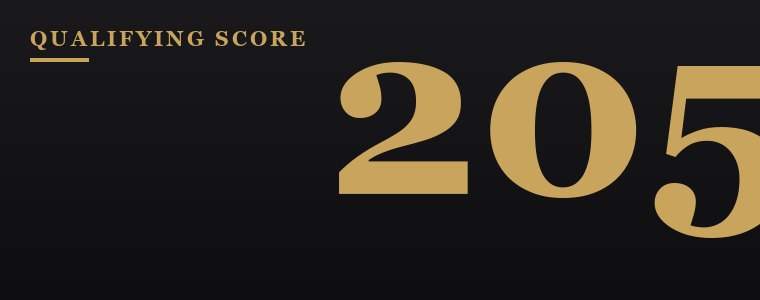
For 2027 entry the King Edward VI Foundation used a qualifying score of 205 and a priority score of 224 across its Birmingham grammar schools (King Edward VI Foundation, results and offers). Queen Mary's Grammar School in Walsall set a minimum qualifying score of 180 for the same test. Same paper, same scale, very different numbers.
Is there a single Birmingham 11+ pass mark?
No, and searching for one is the wrong question. What exists is a shared test sat by candidates for all 19 partnership grammar schools, and a separate set of admissions thresholds published by each school or foundation afterwards.
There is also a second distinction that trips up almost every parent I speak to, and it matters more than the headline number:
- A qualifying or minimum score is a threshold. Below it, an application is not considered at all.
- The lowest score that received an offer is an outcome, not a rule. It is whatever the last successful applicant happened to score once everyone above the threshold was ranked.
Those two numbers can sit a long way apart. Clearing the qualifying score tells you that your child is in the running. It does not tell you that a place is coming, because everyone above the threshold is then ranked against each other and against the school's admissions criteria.
Got a score in front of you? Our 11+ score checker puts it against these published thresholds, and says plainly where a school publishes none.
How the standardised score is worked out
Children sit two papers, each roughly 50 to 60 minutes, made up of smaller separately timed sections covering English comprehension, verbal reasoning, mathematics and non-verbal or spatial reasoning (West Midlands Grammar Schools, the entrance test). All questions are multiple choice.
The sections are not weighted equally. The published weighting is 50% for English and verbal reasoning, 25% for non-verbal reasoning and 25% for mathematics, so comprehension and verbal work carry half the result between them.
Marks are then converted into a standardised score, which does two jobs. It puts every child on a common scale, and it applies an age adjustment so that a child born in late August is not disadvantaged against a classmate born the previous September. Results across the partnership use an age-weighted standardisation around a median score of 200 (Queen Mary's Grammar School, September 2026 entry).
One practical consequence: because the scale is standardised, a harder paper does not disadvantage your child. Everyone is measured against the same yardstick. It also means you cannot work backwards from a raw mark. The schools do not publish raw scores or the number of marks available, so any site quoting a total out of some fixed number is guessing.
Birth month matters less than the things you can control
Every year parents ask me the same thing about fairness in the age-standardised scores: is a September or October child really at a disadvantage against one born in June to August? My honest view, after many years in the 11+ space, is that a few months of age does not define a child's intelligence. I've taught plenty of summer-born children who outperformed older classmates born in the autumn.
So I don't think birth month should be something families fixate on, though I'll be straight with you: a single raw mark genuinely can make the difference between a place and a waiting list. That's exactly why I tell parents the things actually within your control, preparation and disciplined study for the real exam, matter far more than a birthday you can't change.
Mushtaque Ahmed, Founder of GrammarPath and Bright Mentors
What score do you need for a King Edward VI school?
The King Edward VI Foundation publishes two figures each year, and they do different jobs.
| Threshold | 2027 entry | Set by | What it does |
|---|---|---|---|
| Qualifying score | 205 | KE Foundation (Birmingham) | The minimum needed to be considered for a Foundation place at all. Below it, an application is not ranked. |
| Priority score | 224 | KE Foundation (Birmingham) | A higher bar. Reaching it and living inside the catchment lifts an applicant into a stronger admissions category. |
| Minimum qualifying score | 180 | Queen Mary's Grammar School (Walsall) | That school's own eligibility threshold for the same shared test. |
| Lowest score offered a place | around 200 | Queen Mary's Grammar School (Walsall) | An outcome of oversubscription, not a threshold. Marked provisional on the school's own page. |
Both Foundation figures are reset annually once results are in, so treat 205 and 224 as the most recent published benchmark rather than a permanent pass mark. If you want the detail on how catchment interacts with the priority score, I have written that up separately in the King Edward VI catchment and priority scores guide.
Why Walsall's numbers look nothing like Birmingham's
This is where transplanting a number you read somewhere else does real damage. Queen Mary's Grammar School in Walsall published a minimum qualifying score of 180 for 2026 entry, alongside a lowest score offered a place of around 200 and a lowest waiting list score of 225.
Read those three numbers carefully, because they tell a story that a single "pass mark" never could. The eligibility bar sat at 180, but in practice offers ran out at roughly 200, and the waiting list started higher again. A child scoring 185 qualified and still did not receive an offer. That is oversubscription, not failure.
Note also that the school marks its 200 figure as approximate and subject to confirmation by its governors, so it should be read as an indication rather than a fixed line. And Queen Mary's High School, the girls' school in Walsall, does not publish equivalent figures on its admissions pages, so the boys' school numbers should not be assumed to carry across.
Why the national "mean of 100" model does not apply here
If you have read that the 11+ is built around a mean of 100, with grammar entry at roughly 111 or above, that is the generic national GL model. It is a different scale and it does not apply in the West Midlands.
This is the single most common piece of misinformation I have to correct, and it comes from national tutoring sites that cover the whole country thinly and default to the national figures. If you compare a West Midlands score against a national scale, you will draw a conclusion that is wrong by a wide margin in either direction.
The local scale is standardised around a median of 200. That is why every threshold you will see quoted around here, 180, 200, 205, 224, sits in that range rather than in the 100s. When you read a score figure online, the first question to ask is which scale it is on, and the second is which school set it.
See where your child stands today
Timed sections in the GL Assessment format, marked instantly, with a topic-by-topic breakdown. No sign-up to start.
Frequently asked questions
What is the pass mark for Birmingham grammar schools?
There is no single pass mark. The West Midlands grammar schools share one entrance test, but each school or foundation sets its own threshold on the resulting standardised score. For 2027 entry the King Edward VI Foundation used a qualifying score of 205 and a priority score of 224 across its Birmingham grammar schools. Other partnership schools set different numbers, and every figure is reset annually once results are known.
What is a standardised score in the 11+?
A standardised score converts your child's marks onto a common scale and adjusts for age, so that a child born in late August is not disadvantaged against a classmate born the previous September. Results across the West Midlands partnership use an age-weighted standardisation around a median score of 200.
Is the Birmingham 11+ score out of 100?
No. The national GL model that centres on a mean of 100, with grammar entry around 111 and above, is a different scale and does not apply here. West Midlands results are standardised around a median of 200, which is why local thresholds are numbers like 180, 205 and 224 rather than figures in the 100s.
What score do you need for a King Edward VI school?
For 2027 entry, 205 is the qualifying score needed to be considered at all, and 224 was the priority score that, combined with living inside the school's catchment, placed an applicant in a higher ranked admissions category. Reaching 205 does not by itself secure a place, because applicants above that mark are still ranked against each other.
Do all West Midlands grammar schools use the same pass mark?
No, and this is the most common mistake parents make. The test is shared, the thresholds are not. Queen Mary's Grammar School in Walsall set a minimum qualifying score of 180 for 2026 entry, well below the King Edward VI Foundation's 205. Always check the figure published by the individual school you are applying to.