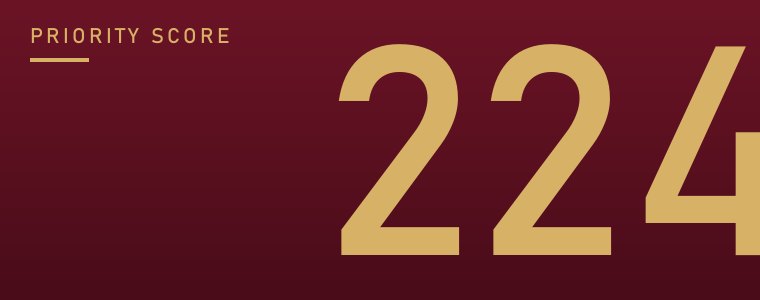
If you are applying to a King Edward VI Foundation grammar school, two separate things decide your child's chances once they have sat the test: where you live, and how far above the qualifying score they scored. The Foundation's grammar schools each publish a catchment area built from named electoral wards, and they use two different score thresholds. The qualifying score is the minimum needed to be considered at all. The priority score is a higher bar that, combined with living inside the catchment, lifts an applicant into a stronger admissions category.
For 2027 entry the Foundation set the qualifying score at 205 and the priority score at 224 across all of its grammar schools (King Edward VI Foundation, results and offers). Both figures are reset every year once results are in, so treat them as the most recent published benchmark rather than a fixed pass mark.
What the King Edward VI catchment area actually is
The catchment is not a radius drawn around the school. It is a defined list of electoral wards, and the Foundation publishes a separate catchment map for each of its grammar schools (Foundation catchment maps). Between them the wards cover parts of Birmingham, Sandwell and Solihull.
Because the boundaries follow ward lines rather than distance, two families a few hundred metres apart can fall on opposite sides. Distance still matters, but only to rank applicants within a category, not to decide whether you are in the catchment at all.
The Foundation grammar schools that publish catchment maps are Aston, Camp Hill for Boys, Camp Hill for Girls, Five Ways, Handsworth Grammar for Boys and Handsworth for Girls. Each has its own map, so being inside one catchment is no guarantee of being inside another. To check your ward, use Birmingham City Council's ward lookup tool, then compare it against the map for each school you are considering.
- Registration closed: 4pm on Friday 26 June 2026
- Entrance test: Saturday 12 September 2026, AM and PM sessions
- Results and score thresholds: published in the autumn term
- Test format: two papers of roughly 60 minutes, covering English comprehension, verbal reasoning, maths and non-verbal or spatial reasoning
Qualifying score vs priority score
This distinction causes the most confusion, and the two numbers do completely different jobs.
| Threshold | 2027 entry figure | What it does |
|---|---|---|
| Qualifying score | 205 | The minimum standardised score needed to be considered for any Foundation grammar school place. Below it, an application is not ranked at all. |
| Priority score | 224 | A higher threshold. Reaching it and living inside the school's catchment places an applicant in a dedicated, higher-ranked category. |
Both figures come from the Foundation's published results and offers page for 2027 entry. The equivalent 2027 figures are confirmed after the September 2026 test, so use 205 and 224 as a guide and check the official page again once the new cycle's numbers are posted.
Scores are standardised for age, so a child born in late August is not disadvantaged against a September-born classmate. That adjustment is applied before any threshold is compared.
How places are allocated, category by category
Each Foundation school publishes its own admissions policy, and the wording varies slightly between them, so always read the policy for the specific school. The shape, however, is consistent. Applicants who meet the qualifying score are sorted into ranked categories, and places are offered from the top down.
Taking King Edward VI Handsworth School for Girls as a worked example, the order runs:
- Looked after and previously looked after children who achieve the qualifying score.
- Pupil premium applicants inside the catchment who achieve the qualifying score, ranked by distance from the school.
- Pupil premium applicants outside the catchment who achieve the qualifying score, capped so that pupil premium places make up around a quarter of the intake if the in-catchment group does not fill it.
- Applicants who achieve the priority score and live inside the catchment, with sibling priority applied first, then ranked by distance.
- All remaining applicants who achieve the qualifying score, ranked by test score, with siblings and then distance separating equal scores.
Read that list again and one thing stands out. The catchment only becomes decisive in the fourth category, and it only helps there if the child has also hit the priority score. In the final category, which is where most families land, the ranking is by score alone.
See where your child stands today
Timed sections in the GL Assessment format, marked instantly, with a topic-by-topic breakdown. No sign-up to start.
Does living in the catchment guarantee a place?
No. This is the most common misunderstanding I hear from parents. Living inside the catchment does not reserve a place and does not lower the score your child needs. It only changes which queue your child stands in, and even inside the priority-score catchment category applicants are ranked by distance until places run out. A catchment address is also no use on its own if your child has not reached the qualifying score: that gate comes first in every category.
What if you live outside the catchment area?
Your child can still be offered a place. Out-of-catchment applicants who meet the qualifying score are ranked in the final category by test score, so a strong score can outweigh a less convenient address.
In practice this reverses the usual advice. Outside the catchment, the score is the lever you can actually influence, so preparation matters more, not less. Inside it, hitting the priority score is what converts that address into a real advantage.
The Foundation is also only one part of the picture. The same West Midlands entrance test is shared across the wider grammar school partnership, so a single sitting feeds applications well beyond the Foundation. Our complete West Midlands 11+ guide covers how that fits together.
How pupil premium changes the picture
Pupil premium applicants occupy the highest-ranked categories after looked after children, which makes this the most powerful priority in the whole framework. Two points are widely misunderstood.
First, pupil premium does not award extra marks. The Foundation is explicit: applicants must achieve the qualifying score on their own merit, and no additional marks are added to the test (Foundation pupil premium guidance). The advantage is in how the application is ranked afterwards, not in the test itself.
Second, eligibility is fixed at the test date. The child must qualify under the government's pupil premium criteria and attend a state-funded primary school receiving that funding for them at the time of the test. Children who become eligible afterwards cannot access pupil premium places, and children who are home educated or at an independent school are not eligible under this criterion. From September 2026 the Foundation has confirmed that only the targeted free school meals cohort attracts this priority.
Treat 205 as the floor, and aim well above it
A crucial thing parents miss: the 205 qualifying score is a baseline, not a guarantee. In 2025/26 I taught pupil premium students scoring 206 and 207, and even that wasn't always enough. One girl scored 206 and had her heart set on King Edward VI Handsworth School for Girls, but didn't receive a place there; she was allocated Queen Mary's High School in Walsall, her second choice. The year before, in 2024/25, that same 206 would very likely have secured the place. The threshold you need shifts year to year with the strength of the cohort, so treat 205 as the floor and aim well above it.
On catchment, I'm blunt with families before they submit their six choices. Putting a school you love but live outside the catchment for high on the list, when Birmingham City Council is processing thousands of applications, creates confusion in your allocation and risks landing you on a waiting list for a school you might otherwise have secured. My message to every parent before they submit is simple: catchment, catchment, catchment.
Mushtaque Ahmed, Founder of GrammarPath and Bright Mentors
Frequently asked questions
Which King Edward VI schools have a catchment area?
The Foundation publishes a catchment map for each of its grammar schools: Aston, Camp Hill for Boys, Camp Hill for Girls, Five Ways, Handsworth Grammar for Boys and Handsworth for Girls. Each school has its own separate map, so you may be inside one catchment and outside another.
How do I check if I live in the King Edward VI catchment?
Catchments are defined by electoral ward, not by distance. Find your ward using Birmingham City Council's ward lookup tool, then check that ward against the published catchment map for each school you are interested in.
What was the King Edward VI priority score for 2027 entry?
The priority score for 2027 entry was 224, and the qualifying score is 205, across all of the Foundation's grammar schools. Both are set annually by the Foundation after results, so confirm the current cycle's figures on the official results and offers page before relying on them.
Can my child get a place without reaching the priority score?
Yes. The priority score only affects one specific category, for applicants who also live inside the catchment. Applicants who reach the qualifying score are still ranked in the final category by test score, and places are regularly offered from it.
Does pupil premium give my child extra marks in the test?
No. Pupil premium applicants must achieve the qualifying score without any additional marks. What pupil premium status changes is the ranking category the application falls into afterwards, which is applied once scores are known.