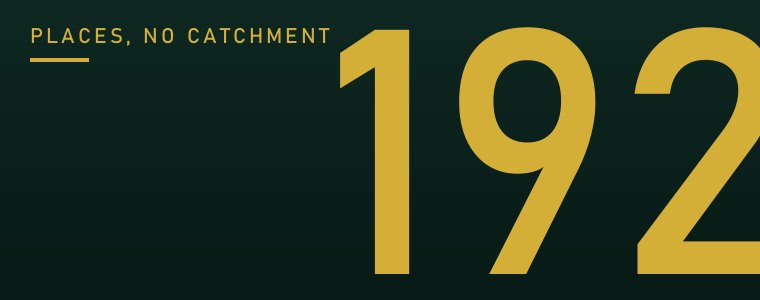
Bishop Vesey's is the Birmingham grammar school where your address barely matters. It admits 192 boys into Year 7, and unlike every King Edward VI school it has no catchment area at all and gives no priority to siblings. Places go to the highest scorers (Bishop Vesey's admissions policy 2026).
It is not a King Edward VI Foundation school, so it sets its own admissions arrangements rather than using the Foundation's. It does use the same shared entrance test, and for 2027 entry it published the same qualifying score of 205 (the school's admission information page).
What makes Bishop Vesey's different
Two absences do the work here, and both cut against what families have learned to expect from the Foundation schools.
There is no catchment area. The word does not appear anywhere in the admissions policy, and none of the oversubscription criteria refer to where you live. A family in Wolverhampton and a family across the road from the school are treated identically, provided both boys clear the qualifying score.
There is no sibling priority. An older brother already at the school does not help a younger brother's application. That is a sharp break from the Foundation schools, where sibling status is a tie-breaker, and from the two Handsworth schools and the two Camp Hill schools, whose policies count a sibling at the paired school as a valid claim.
Distance appears only once, as the final tie-break when two boys have exactly the same standardised score, measured in a straight line to the foot of the steps at the main entrance (Bishop Vesey's admissions policy 2026).
How places are allocated
Where the Foundation schools work through five categories, Bishop Vesey's has three (Bishop Vesey's admissions policy 2026):
| # | Category | Ranked by |
|---|---|---|
| 1 | Looked after, previously looked after, and internationally adopted previously looked after children who achieve the qualifying score | Standardised score |
| 2 | Children attracting the pupil premium who achieve the qualifying score, capped at 38 pupils | Standardised score |
| 3 | All other children who achieve the qualifying score | Standardised score, then distance as a tie-break |
Read that last column again. Every category is ranked by test score. There is no category that rewards an address, and no category that rewards a sibling. Once a boy clears the qualifying score, the mark is very nearly the whole story.
The pupil premium cap is a number, not a share
The Foundation schools reserve up to 25% of places for pupil premium applicants. Bishop Vesey's instead caps that category at 38 pupils, which against a 192 place intake works out at just under 20% (Bishop Vesey's admissions policy 2026).
One procedural detail catches families out every year: parents must tick the pupil premium box when registering for the test. Eligibility is based on registration for free school meals at any point in the six years before the test registration closing date, but claiming it late does not work.
What score do you need?
Bishop Vesey's published a qualifying score of 205 for 2027 entry, the same figure the King Edward VI Foundation used (the school's admission information page). The school does not publish a priority score, because it has no catchment category for one to apply to.
That makes the practical target different from a Foundation school. There is no threshold that unlocks a better category, so the only question is how high you rank among everyone who cleared 205. The entrance test itself is the shared two-paper West Midlands test (West Midlands Grammar Schools, the entrance test), so preparation is identical to any other partnership school.
What this means for your application
For families outside every Foundation catchment, Bishop Vesey's is often the most realistic grammar school on the list, because the thing that excludes them elsewhere simply is not a factor here. That is worth knowing before you rank your preferences.
For families who are inside a Foundation catchment, the calculation is different: at Vesey's you give up the advantage your address buys you elsewhere, and compete on the mark alone. Neither is better in the abstract. It depends entirely on whether your strength is where you live or how your son scores.
There is a fuller comparison of all eight Birmingham grammar schools in the complete guide.
Ask which school fits your son, not which school is better
One thing I would particularly highlight to families living in Castle Vale is that, depending on your exact address and the current admissions arrangements, you may have the opportunity to consider both King Edward VI Aston and Bishop Vesey's Grammar School when looking at grammar school options for your son. This is something I don't think every parent is aware of.
If you are in this position, I would strongly recommend checking your exact address against the latest catchment and admissions criteria for both schools before making any assumptions.
For me, the important thing is not simply asking, "Which school is better?" Instead, I would ask: "Which school is the better fit for my son?" Both schools can provide an excellent academic environment, but parents should consider the individual child, the journey, the school's environment and, of course, the relevant admissions arrangements.
Mushtaque Ahmed, Founder of GrammarPath and Bright Mentors
See where your child stands today
Timed sections in the GL Assessment format, marked instantly, with a topic-by-topic breakdown. No sign-up to start.
Frequently asked questions
Does Bishop Vesey's have a catchment area?
No. The school's 2026 admissions policy contains no catchment area, and none of its oversubscription criteria refer to where a family lives. Distance is used only as a tie-break when two applicants have exactly the same standardised score.
How many places does Bishop Vesey's offer?
The published admission number is 192 boys into Year 7. The school also has a separate Sixth Form external admission number of 80.
Do siblings get priority at Bishop Vesey's?
No. The admissions policy gives no priority to siblings, so an older brother already at the school does not strengthen a younger brother's application. This differs from the King Edward VI Foundation schools, where sibling status acts as a tie-breaker.
What score do you need for Bishop Vesey's?
For 2027 entry the school published a qualifying score of 205, the same figure used by the King Edward VI Foundation. There is no priority score, because the school has no catchment category for one to apply to, so applicants who clear 205 are ranked purely by standardised score.
How does the pupil premium category work at Bishop Vesey's?
Pupil premium applicants who achieve the qualifying score form the second of three categories, capped at 38 pupils rather than a percentage. Parents must tick the pupil premium box when registering their child for the entrance test, and eligibility rests on free school meal registration at any point in the six years before the registration closing date.