Two weeks, one form, and no second attempt
Results arrive in the middle of October. The local authority preference form is due by 31 October. In that fortnight you have to turn a score into a ranked list of schools, and the list you submit is the one that gets used.
This is the hardest fortnight of the whole process to advise on, and the mistakes families make in it are rarely about the score. They are about the ordering.
How ranking actually works
The commonest belief I meet is that putting a school first improves your chances there. It does not, and understanding why changes how you fill the form in.
Under the equal preference system used across English admissions, each school considers your child against its own criteria without knowing where you ranked it. If more than one school would offer a place, you receive an offer from the highest-ranked of those, and the others are released.
Two consequences follow, and they matter:
- Ranking an ambitious school first costs you nothing at the schools below it. You are not "wasting" a preference.
- The order only decides between offers you would have received anyway. So rank by what you actually want, in true order of preference.
Where families go wrong is ranking strategically: putting a school second because they think it is more realistic, and then receiving an offer from it while a school they preferred would also have said yes.
Last year's table, and why it misleads
Every family arrives with a table of last year's figures, and the table is genuinely complicated. For any one school you might be looking at a minimum qualifying score, last year's cut-off, and the score of the last child actually offered a place. Those are three different numbers measuring three different things.
Queen Mary's Grammar School in Walsall illustrates it well. For 2026 entry it publishes a Minimum Qualifying Score of 180, a lowest score offered a place of around 200, and a lowest score on the waiting list of 225. Reading the middle figure as "the score you need" would be wrong in both directions.
| The figure | What it measures | QMGS, 2026 entry |
|---|---|---|
| Minimum Qualifying Score | The threshold to be considered at all | 180 |
| Lowest score offered a place | An outcome of that year's competition | around 200 |
| Lowest score on the waiting list | How far down the list moved | 225 |
Three numbers, three different meanings, one school, one year. Quoting any of them as "the score you need" is wrong, and which one you quote changes the answer by 45 marks.
And all of it is last year's data. It describes how that particular year's cohort happened to fall. It is context, not a target, and treating it as a target is what produces the one-mark heartbreak below.
What two marks actually looked like
Two of my students last year make the point better than any table.
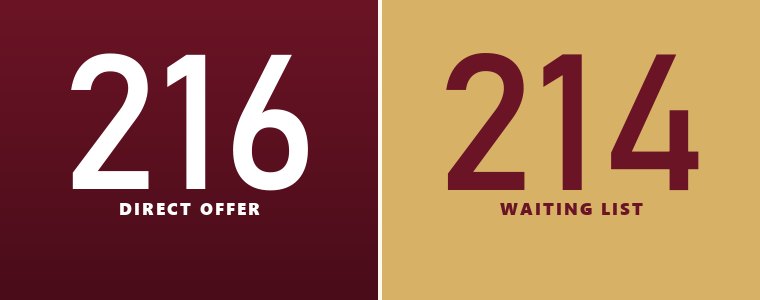
One scored 216, was not eligible for pupil premium, and received a direct offer from King Edward VI Handsworth straight away.
The other scored 214. No offer. They went onto the waiting list, and eventually got a place, but a year later and by a different route entirely.
Two marks. Same preparation, same ambition, families a few streets apart. That is the margin this process runs on, and it is precisely why a preference list should not be built around a number you saw in a table.
Catchment does more work than the score
The single best thing you can do before results day is understand catchment properly, for every school on your shortlist.
The King Edward VI schools use ward-based catchment areas that differ school by school, so the same address can be inside one and outside another. Two children with identical scores get different outcomes for this reason far more often than for any other.
Our guide to Foundation catchment and priority scores sets out the wards, and it is worth reading in September rather than the week the results land.
Building the list
- List the schools you would genuinely be happy with, before looking at any scores.
- Check catchment for each, by ward.
- Put them in true order of preference. Not strategic order.
- Use all your preferences. An unused slot helps nobody.
- Include a realistic non-selective option you would accept, because a form with only grammar schools on it can end with no offer at all.
- Do not remove a school over one or two marks. See above.
After you submit
Offers come from your local authority in the first days of March. For 2027 entry the King Edward VI Foundation gives the date as 1 March 2027.
If the offer is not what you hoped for, the waiting list is a real route rather than a consolation, as those two students show. Accept the offer you have, stay on the lists you want, and treat the two as separate decisions.
For what the score itself means, see our guide to results day.
See where your child stands today
Timed sections in the GL Assessment format, marked instantly, with a topic-by-topic breakdown. No sign-up to start.
A 216 got a direct offer. A 214 waited a year. That is the margin
Once the 11+ result is out, this is the most tricky thing for me as a tutor. I try to guide parents, but with the number of families we deal with it can become quite overwhelming, especially for parents who do not want to read a forum or do their own research.
The most common mistake, and we get the same thing every year, is that parents believe they understand how to apply, and then make a mistake in the order of preference. I always emphasise catchment and the qualifying school. The issue is that there is normally a table you go by from the previous year, and that table becomes complicated: you have the minimum qualifying score, last year's cut-off score, the score of the last person to get a place. You are going by data from the previous year, which is not guaranteed.
One or two marks makes all the difference. I had two students last year. One got 216, was not pupil premium, and got an offer from King Edward VI Handsworth straight away. The other got 214, did not get an offer, and therefore for the sake of two marks ended up on a waiting list. They eventually got a place a year later, but not a direct offer.
This problem comes up every single year, and the more understanding a family has of catchments, the better they do.
Mushtaque Ahmed, Founder of GrammarPath and Bright Mentors
Frequently asked questions
Does putting a school first improve my chances there?
No. Under the equal preference system, each school considers your child against its own criteria without knowing where you ranked it. If more than one would offer, you receive the highest-ranked of those offers. So ranking an ambitious school first costs you nothing at the schools below it.
What order should I put my school preferences in?
True order of preference, not strategic order. The ranking only decides between offers you would have received anyway, so putting a school second because it feels more realistic can mean receiving an offer from it while a school you preferred would also have said yes.
Should I use all my preferences?
Yes, and include a realistic non-selective option you would accept. An unused slot helps nobody, and a form listing only grammar schools can end with no offer at all, at which point the local authority allocates a place wherever one remains.
How much difference do one or two marks make?
It can be the difference between a direct offer and a waiting list. Two of my students last year scored 216 and 214: the first received a direct offer from King Edward VI Handsworth, the second went onto the waiting list and was placed a year later by a different route.
Can I rely on last year's scores?
Only as context. For any school you may be looking at a minimum qualifying score, last year's cut-off, and the score of the last child actually offered a place, which are three different measures. Queen Mary's Walsall publishes 180, around 200 and 225 for those three. All of it describes how one year's cohort happened to fall.
What happens if we do not get an offer we want?
Offers are made in the first days of March, and for 2027 entry the Foundation gives 1 March 2027. Waiting lists are a genuine route rather than a consolation. Accept the offer you have, stay on the lists you want, and treat those as two separate decisions.