Fractions, decimals and percentages are one topic wearing three hats, and a child who can convert instantly between them has made most of these questions easy.
The conversions below are worth knowing by heart. Not worked out each time. Known.
Maths carries 25% of the marks, according to the partnership entrance test page. Almost all of it arrives as worded problems rather than bare calculations, which is the part that catches children out.
The table to learn by heart
| Fraction | Decimal | Percentage |
|---|---|---|
| 1/2 | 0.5 | 50% |
| 1/4 | 0.25 | 25% |
| 3/4 | 0.75 | 75% |
| 1/5 | 0.2 | 20% |
| 2/5 | 0.4 | 40% |
| 1/8 | 0.125 | 12.5% |
| 1/10 | 0.1 | 10% |
| 1/3 | 0.333... | 33.3% |
A child who has to derive 3/4 equals 75% in the middle of a timed section has already lost the question, because the real work was somewhere else.
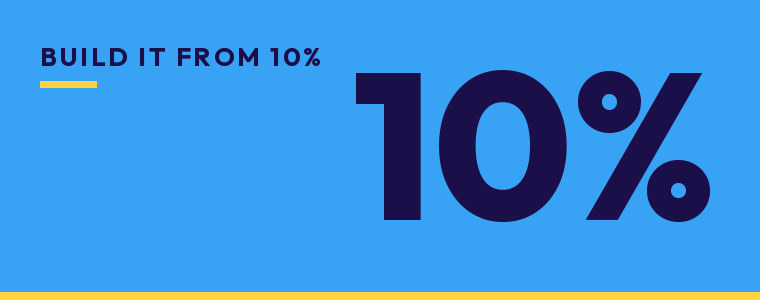
Percentages of an amount: build them from 10%
Do not reach for a formula. Build the answer from parts a child can find in their head.
What is 15% of 240?
- 10% of 240 is 24. Move the digits one place.
- 5% is half of that, so 12.
- 15% is 24 plus 12, which is 36.
The same method handles almost anything. 10% gives you 20%, 30%, 5%, 15%, 25% and more, all by doubling and halving.
Fractions of an amount
What is 3/8 of 64?
Divide by the bottom, multiply by the top. 64 divided by 8 is 8, and 8 times 3 is 24.
Say the rule aloud as "divide by the bottom, times by the top" until it is automatic. Children who try to multiply first end up with large numbers and more chances to slip.
The reverse percentage, which is where marks are lost
This is the question type that separates the field, and it appears regularly.
A coat costs £36 in a sale after 25% off. What was the original price?
The trap is adding 25% of 36 back on, giving £45. That is wrong, because the 25% was taken off the original price, not off the sale price.
Work it properly:
- £36 represents 75% of the original, because 25% was removed.
- So 1% is 36 divided by 75, which is 0.48.
- 100% is 0.48 times 100, which is £48.
Check it: 25% of 48 is 12, and 48 minus 12 is 36. It works.
Always check a reverse percentage by running it forwards. It takes ten seconds and it is the only way to catch the £45 error.
Why these arrive as word problems
In this test you will rarely be asked "what is 15% of 240". You will be told about a shop, a recipe or a journey, and have to work out that 15% of 240 is what is being asked.
So practise the comprehension as well as the arithmetic. Underline the numbers, write down what is actually being asked, and only then start calculating.
See our guide to 11+ maths topics.
See where your child stands today
Timed sections in the GL Assessment format, marked instantly, with a topic-by-topic breakdown. No sign-up to start.
One question, three topics, all at once
My background is in mathematics and I have taught it all the way to A level, which has helped me understand how children in Year 3, 4 and 5 actually take these concepts on. And every single year we have a large number of students who find worded problems very difficult.
That matters because the majority of the 11+ maths examination is based on worded problems. The child has to comprehend and understand what is being asked, and then use their applied understanding of formulas from different topics and put them together. A question might ask them to apply percentages to weight and proportion, so there are three separate topics all combined and all required to unlock that one question. First they have to understand it, then apply it.
That is why we give every student a formula sheet in the form of a mind map and get them to memorise it. When it comes to application they can recall the formula and use it without stopping to think. The speed of answering is what causes a lot of children to make mistakes and get lower marks in mathematics, because they cannot work out what is being asked and then choose which formula to apply quickly enough.
Mushtaque Ahmed, Founder of GrammarPath and Bright Mentors
Frequently asked questions
How do you find a percentage of an amount in the 11+?
Build it from 10%. To find 15% of 240, take 10% which is 24, halve it to get 5% which is 12, then add them for 36. Doubling and halving from 10% covers 5%, 20%, 25%, 30% and most other percentages a child will meet.
How do you work out a fraction of an amount?
Divide by the bottom number, then multiply by the top. For 3/8 of 64, divide 64 by 8 to get 8, then multiply by 3 to get 24. Doing it in that order keeps the numbers small and reduces the chance of a slip.
How do you solve reverse percentage questions?
Work out what percentage the figure you have represents. If a coat costs £36 after 25% off, then £36 is 75% of the original, so 1% is 0.48 and the original was £48. Always check by running it forwards: 25% of 48 is 12, and 48 minus 12 is 36.
Why is adding the percentage back on wrong?
Because the discount was taken off the original price, not off the sale price. Adding 25% of £36 gives £45, which is wrong: the correct answer is £48. It is one of the most common errors in 11+ maths and checking the answer forwards catches it every time.
Which fraction and percentage conversions should my child memorise?
At minimum a half, a quarter, three quarters, a fifth, two fifths, an eighth, a tenth and a third. A child who has to derive that three quarters is 75% during a timed section has already lost time that the real part of the question needed.