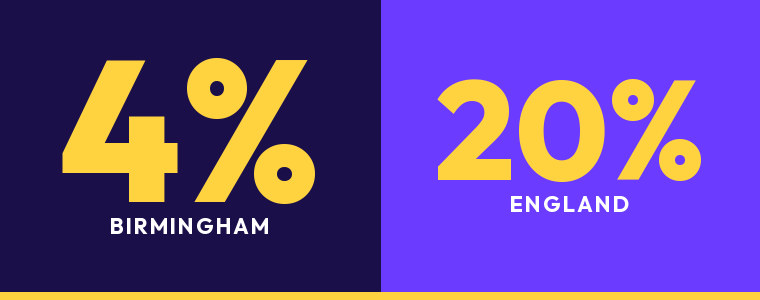
Birmingham heard 422 secondary transfer appeals in 2025 and upheld about 4% of them. That is the honest figure, and it is the first thing any family considering an appeal should see.
This article is built on published statistics rather than on anecdote, because appeal outcomes are one of the few parts of this process where real numbers exist and where reassurance does families genuine harm.
The actual odds
| Appeals | Heard | Upheld |
|---|---|---|
| Birmingham secondary transfer, 2025 | 422 | about 4% |
| Birmingham secondary transfer, 2024 | 476 | 3.9% |
| Birmingham secondary transfer, 2023 | 427 | 6% |
| England, all secondary appeals, 2025 | 29,640 | 19.9% |
Sources: Birmingham City Council's Year 7 appeals page and the Department for Education's admission appeals statistics. Note the gap. Nationally about one secondary appeal in five succeeds. In Birmingham it is closer to one in twenty five.
One caveat worth stating plainly: Birmingham's published figures cover secondary transfer appeals as a whole and are not broken down by school, so they are not a grammar-school-only number. They are the closest published figure to your situation, and they are not encouraging.
Why selective appeals are harder than ordinary ones
An appeal for an oversubscribed comprehensive asks one question: does the disadvantage to your child outweigh the difficulty the school would face in admitting another pupil?
A grammar school appeal asks that and something harder first. You have to persuade the panel that your child is of the required academic standard despite a test result saying otherwise, and then explain why the test did not show it.
The panel cannot re-mark the paper or assess your child directly. That is not within its power under the School Admission Appeals Code. So you are asking a panel of lay members to prefer your evidence over a standardised test sat by thousands of children on the same morning.
Where that has been measured separately the effect is stark. In Buckinghamshire, the largest fully selective area in England, 105 qualified grammar school Year 7 appeals were heard in 2025 and 7 succeeded, a rate of about 7%. For children who had not reached the qualifying standard the rate was 3% after a selection review and 0% without one. Non-selective upper school appeals in the same county ran at 28%.
What actually counts as a ground
Panels respond to evidence, not to disappointment. The arguments that carry weight are specific and documented.
- Documented illness on the day, with medical evidence dated at the time, not written afterwards.
- A bereavement or serious family disruption close to the test.
- A procedural error by the school or the local authority in handling your application.
- Strong, independent evidence of academic standard: school reports, teacher assessments, Key Stage 2 data, work samples that pre-date the test.
What does not work, and is heard constantly: that your child was nervous, that they were close to the mark, that siblings attend the school, that you have moved house, or that the child has worked very hard. Those are true and they are not grounds.
Timing
Offers arrive on National Offer Day, 1 March. You normally have at least 20 school days from the date of the decision letter to lodge an appeal, and the deadline is in the letter itself. Miss it and the appeal may still be heard, but after the on-time ones.
Accept the place you have been offered first. Accepting does not weaken an appeal and it does not remove you from any waiting list. Declining it leaves you with nothing if the appeal fails.
The waiting list is usually the better bet
This is the practical conclusion, and it is where I would put a family's energy.
Waiting lists in Birmingham move. Clearance runs from March, and allocations continue through the spring and into the summer as families accept places elsewhere. That is a real route, it costs you nothing, and on the published figures it is a better prospect than a 4% appeal.
Do both if you have genuine grounds. If you do not have grounds, put the effort into the lists and into the schools you have not yet called. See our guide to how waiting lists really move and our guide to missing the qualifying score.
See where your child stands today
Timed sections in the GL Assessment format, marked instantly, with a topic-by-topic breakdown. No sign-up to start.
Put the fortnight into phone calls, not into an appeal
I want to be straight about the limits of what I can tell you here. I do not take families through appeal hearings, so I am not going to pretend to know what wins one. The numbers on this page come from Birmingham City Council and the Department for Education, not from me.
What I do see every October is where families put their energy, and it is often in the wrong place. The moment a result comes in under the threshold, the conversation turns to appeals and what went wrong. Usually nothing went wrong. They are measuring a decent result against the wrong ruler, because the 205 is one foundation's number for its own schools and it carries no authority elsewhere in the partnership.
So before anyone starts drafting an appeal, I would make the calls. Get on the waiting lists. Phone Walsall and Wolverhampton, where the thresholds are set lower and the same test result counts. The waiting lists genuinely move from March onwards. I would far rather a family spent that fortnight finding the places that are actually available than rehearsing an argument they may not need.
Mushtaque Ahmed, Founder of GrammarPath and Bright Mentors
Frequently asked questions
What are the chances of winning an 11+ appeal in Birmingham?
Low. Birmingham heard 422 secondary transfer appeals in 2025 and upheld about 4% of them, against a national secondary figure of 19.9%. Those Birmingham figures cover secondary transfer as a whole rather than grammar schools specifically, but they are the closest published measure of what a family is taking on.
Why are grammar school appeals harder to win?
Because there are two hurdles rather than one. You must persuade the panel that your child is of the required academic standard despite a test result indicating otherwise, and then that the disadvantage to your child outweighs the difficulty of admitting another pupil. The panel cannot re-mark the paper or assess the child itself.
What are valid grounds for an 11+ appeal?
Documented illness on the test day with contemporaneous medical evidence, a bereavement or serious family disruption close to the test, a procedural error by the school or local authority, or strong independent evidence of academic standard such as school reports and work predating the test. Nerves, being close to the mark, siblings at the school and hard work are not grounds.
How long do I have to appeal a school place decision?
Normally at least 20 school days from the date of the decision letter, with the exact deadline stated in the letter. Offers are issued on National Offer Day, 1 March. Appeals lodged late may still be heard but will be scheduled after the on-time ones.
Should I accept the school place I was offered before appealing?
Yes. Accepting the offered place does not weaken an appeal and does not remove your child from any waiting list. Declining it leaves you with nothing if the appeal is unsuccessful.
Is a waiting list better than an appeal?
On the published figures, usually yes. Birmingham waiting lists clear from March and continue moving through spring and summer as families accept places elsewhere, which costs you nothing and is a better prospect than an appeal running at around 4%. Pursue both if you have genuine grounds.